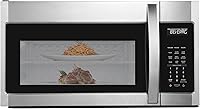
Are LG Over-the-Range Microwaves Good?
Yes, LG over-the-range microwaves are good for most kitchens. They combine a microwave and a vent hood in one 30-inch unit, and LG's models cover the basics well without a premium price.
On this page (8 sections)
- What makes an over-the-range microwave good in the first place?
- Are over-the-range microwaves good at cooking and venting?
- Are over-the-range microwaves reliable?
- Which over-the-range models are worth comparing?
- What are the real drawbacks of over-the-range microwaves?
- How do you choose the right over-the-range microwave?
- Who should buy an over-the-range microwave?
- So, are LG over-the-range microwaves good?
Yes, LG over-the-range microwaves are good for most kitchens. They put a microwave and a vent hood in one 30-inch unit, and ordinary over-the-range models cover the everyday basics well.
The bigger question is whether any over-the-range microwave fits your kitchen. This guide looks at what makes these units work, which models earn a place, and what to weigh before you buy.
What makes an over-the-range microwave good in the first place?
A good over-the-range microwave cooks evenly and vents well without taking up counter space. Those two jobs are the reason people choose this type over a countertop model.
Look at cooking power first. A 1,000-watt unit handles reheating and everyday cooking, while the power levels and preset settings decide how easy it is to use.
Then check the vent system: airflow in CFM, fan speeds and whether it recirculates or vents outside.
Fit matters just as much. Most units are 30 inches wide to match the space over a standard range, but depth and height vary.
Measure your cabinet gap before you order.
Finally, think about the extras you'll actually use, like sensor cooking, a turntable on/off switch and lighting over the cooktop. Those details separate a convenient unit from one you fight with.
Are over-the-range microwaves good at cooking and venting?
Over-the-range microwaves are good at both jobs for everyday cooking. They're built around 1,000-watt cooking power and multi-speed vent fans, the same recipe the mainstream brands follow.
The models here give you 300 to 400 CFM of airflow. That's plenty for reheating, simmering and light frying.
A 300 CFM fan like the GE JVM3160RFSS's handles small kitchens and occasional cooking, while 400 CFM clears steam and odors faster when you cook often.
The controls are where the modern models feel current. Touch pads, one-touch express settings and preset cook menus keep daily use simple.
Sensor cooking on some models adjusts time and power for you.
GE Profile also offers a low-profile model for kitchens where a full-size unit would crowd the cabinets. If space above the range is tight, that shape matters more than raw capacity.
Are over-the-range microwaves reliable?
Over-the-range microwaves are generally reliable, but that's not unique to LG: reliability depends on the model, not the brand. The parts that tend to wear are the door switch, the control board and the vent fan motor.
A simple control panel with fewer features often has less to go wrong than a touchscreen-heavy one.
Warranty coverage varies by model. Check what the maker covers for the magnetron and the rest of the unit before you buy, since parts coverage often differs from labor coverage.
If reliability is your main concern and you want to compare brands directly, see are GE over the range microwaves reliable for a read on the other big name in this category. Both brands build similar 30-inch units, so the model matters more than the badge.
Which over-the-range models are worth comparing?
Three 30-inch units cover the main choices: the GE JVM3160RFSS for simple everyday value, the Toshiba for family-size capacity and vent power, and the GE Profile low profile for tight spaces. Each one shows what matters most in this category.
Where the GE model stands out
The GE 1.6 Cu Ft Over-the-Range Microwave (JVM3160RFSS) is a 30-inch unit with 1,000 watts, 10 power levels and a 300-CFM two-speed vent. Its one-touch express settings and four convenience cook settings keep daily use quick.
A 12.8-inch turntable handles larger dishes, and the child lock suits shared kitchens.
If you want more of a read on that model, our GE JVM3160RFSS review covers its features in detail.
Where the Toshiba model stands out
The Toshiba 1.9 Cu Ft Over-the-Range Microwave brings a bigger 1.9 cu ft cavity and a 13.5-inch turntable for family-size cooking. Its 400-CFM two-speed fan and sensor cooking suit open kitchens and frequent cooking.
A flip-and-lock bracket and soft-close door make installation easier and quieter.
For a head-to-head read, our Toshiba vs GE microwave comparison shows which one fits your kitchen habits.
When low profile matters
The GE Profile 1.2 Cu Ft Low Profile Over-the-Range Microwave, Stainless fits over the range in the same space as a regular under-cabinet hood. That shape keeps countertop space and sightlines clear.
Its 400-CFM two-speed vent, sensor cooking and LED cooktop lighting cover the basics well.
If you're also weighing a budget name, our BLACK+DECKER vs Kenmore microwave comparison covers two lower-cost options.
What are the real drawbacks of over-the-range microwaves?
The main drawbacks are shared with the whole category, not unique to any one brand. Knowing them helps you buy with your eyes open.
- Limited vent power. Most units sit around 300 to 400 CFM, which won't match a dedicated 600 CFM range hood for heavy searing or wok cooking.
- Height and clearance. A full-size unit takes vertical space above the range and can block the back burners.
- Installation weight. These units are heavy and need two people, plus the right ducting or recirculating setup.
- Feature overload. Touchscreen-heavy models add parts that can fail and menus you may never use.
None of these is a reason to avoid this type of microwave. They're reasons to match the model to your kitchen instead of buying the biggest unit you can find.
How do you choose the right over-the-range microwave?
Choose the right over-the-range microwave by matching vent setup, size and cooking habits to the model. Start with the vent path, since that decision is hardest to change later.
Venting: ducted or recirculating
If your kitchen already has ductwork to the outside, a ducted setup vents smoke and odors out. If not, a recirculating unit passes air through a charcoal filter and back into the room.
Check which mode the model supports and what filter it needs.
Size and fit
Measure the width of the space over your range and the height under the upper cabinets. Most units are 30 inches wide, but depth and height differ.
A low-profile model helps when vertical space is tight.
Capacity and cooking features
A 1.2 cu ft cavity suits singles and couples, while a 1.6 to 1.9 cu ft unit fits families and larger dishes. Sensor cooking and express settings are the features most people use daily.
Noise and controls
Fan noise rises with airflow, so a two-speed fan lets you drop to low for quick reheating. Simple touch controls with a few presets tend to be easier to live with, and a sound adjustment or mute helps in quiet kitchens.
Who should buy an over-the-range microwave?
Buy an over-the-range microwave if you want a mainstream 30-inch unit that combines cooking and venting without a premium price. It suits kitchens where a dedicated hood isn't practical and counter space is limited.
Skip it if you do heavy high-heat cooking and need more vent power than 400 CFM, or if you want the simplest possible controls. In those cases, a dedicated range hood or a basic microwave might serve you better.
Whatever brand you pick, confirm the vent setup and measure your cabinet space first. That one step decides more about your satisfaction than the logo on the door.
So, are LG over-the-range microwaves good?
Yes, over-the-range microwaves are good for most buyers, as long as the model matches your vent setup and cabinet space. They handle everyday cooking and light venting well and keep your counter clear.
The decision rule is simple. Pick a standard 30-inch all-in-one with straightforward controls if that's what your kitchen needs.
Pick a low-profile model if space above the range is tight. Pick a larger 1.9 cu ft unit like the Toshiba if you cook for a family and want more vent power.
Before you order, check the vent path, measure the opening and decide how much airflow you actually need. For more brand comparisons, our brand matchups hub rounds up the options side by side.
Frequently asked questions
Do LG over-the-range microwaves vent outside?
Most LG over-the-range models can be set up to vent outside through ductwork or to recirculate air through a charcoal filter. Which one you get depends on the model and how it's installed, so match the setup to your kitchen before you buy.
How many CFM should an over-the-range microwave have?
A vent fan around 300 CFM handles light everyday cooking, while 400 CFM clears steam and odors faster in a busy kitchen. Higher airflow needs ductwork sized for it, so check your setup if you cook often.
What size over-the-range microwave fits a standard cabinet?
Most over-the-range microwaves are 30 inches wide to match the space above a standard range. Measure width, depth and the clearance under your upper cabinets before ordering, since height varies by model.
Is an over-the-range microwave hard to install?
It's a two-person job because the unit is heavy and mounts to the wall and upper cabinet. A model with a simpler bracket, like the Toshiba flip-and-lock design, can shorten the time, but you still need a helper to lift it.
Does an over-the-range microwave replace a range hood?
Yes, in most kitchens it does the venting job while adding microwave cooking above the stove. It works best when its airflow and vent setup match your cooking style and the ducting in your home.