Best 30-Inch Range Hood Inserts: Top 7 Picks (November 2026)
The best 30-inch range hood inserts include the IKTCH 30 inch Insert Range Hood 900 (best overall), the IKTCH Range Hood Insert 30 inch 900 for remote control, and the Zomagas Range Hood Insert 30 inch for simple push-button control.
On this page (8 sections)
- The best 30 inch range hood inserts, ranked by what they do well
- How the seven inserts compare side by side
- How we compared these 30 inch range hood inserts
- What should you check before buying a 30 inch insert?
- How much airflow does your cooking actually need?
- Ducted or ductless: which setup suits your kitchen?
- Controls and filters: what makes daily use easier?
- Which 30 inch range hood insert should you buy?
The best 30 inch range hood insert for most kitchens is the IKTCH 30 inch Insert Range Hood 900, because 900 CFM of airflow, gesture control and a 40 dB low setting cover everyday cooking without shouting over the fan. Pick the VIKIO HOME for the highest airflow, the Zomagas for simple buttons, or the AURAKICH for a black kitchen with a full ductless kit.
A range hood insert hides the vent in your cabinet and leaves only the slim underside showing. That built-in look is why so many kitchen remodels skip the boxy hood and go this route.
The catch is that the insert has to fit your cabinet cut-out, match your duct plan and move enough air for the way you cook. Get those three right and the rest is preference.
This guide compares seven 30 inch inserts on airflow, noise, controls, filters and how each one installs. Our scores weigh specs, features and buyer feedback against what you're shopping for.
If you're still deciding between a hood and a microwave hood, read over the range microwave vs range hood first, since the two solve the same problem in different ways.
Our picks at a glance
-
1

-
2
-
3
 Best for simple push-button control
Zomagas Range Hood Insert 30 inch
9.5/10 our score
See it on Amazon
- 4
 Best for compact cabinetsCheck it
- 5
 Check it
VIKIO HOME 30 Inch Range Hood Insert
Best for high-heat cooking - 6
 Best for touch and remote controlsCheck it
- 7
 Check it
AURAKICH Black Range Hood Insert 30 inch
Best for a black kitchen
The best 30 inch range hood inserts, ranked by what they do well
The IKTCH 900 is the strongest all-round pick, while each model below earns its place for a specific kitchen. Read the airflow and noise figures together, since a powerful fan that runs loud at low speed gets switched off more often than one that's quiet when you need it.
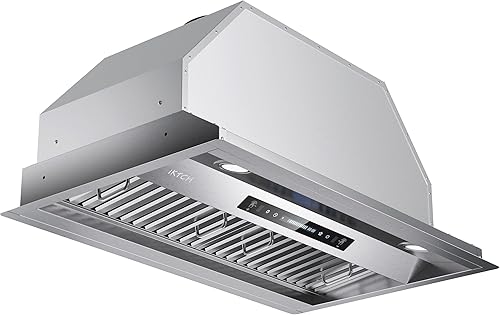
IKTCH 30 inch Insert Range Hood 900: Best overall
- 900 CFM maximum airflow
- 4 fan speeds
- Gesture and touch controls
- 40 dB on the lowest setting, 65 dB at maximum
The top pick for most kitchens: strong airflow, hand-wave control and a low-speed noise figure that suits open-plan homes.
Pros
- 900 CFM maximum airflow
- 40 dB on the lowest setting
- Gesture control keeps greasy hands off the panel
Cons
- 65 dB at full speed
- Remote control adds another thing to store
IKTCH's top insert fits most standard 30 inch cabinets and gives you two ways to run the fan without touching a greasy panel. Wave a hand in front of the sensor to start or stop it, or use the touch controls and the included remote when your hands are full.
The 900 CFM maximum is enough for gas burners and frequent frying. More useful day to day is the 40 dB figure on the lowest speed, which lets you run the fan through a long simmer without drowning out conversation.
Two 3W LED lamps adjust in brightness, and the pair of stainless baffle filters come out for the dishwasher. The body is 27.75 inches wide, so measure your opening against that before ordering.
Buy it if you want the best balance of power, quiet running and modern controls in this group. The 65 dB top speed is the trade-off you accept for that 900 CFM ceiling.
IKTCH Range Hood Insert 30 inch 900: Best for remote control
- 900 CFM maximum airflow
- Remote control included
- Ducted or ductless convertible
- 2 adjustable LED lights
The same 900 CFM motor as the top pick, but the remote control lets you change speeds from across the kitchen.
Pros
- 900 CFM maximum airflow
- Remote control included
- Adjustable LED lights on both sides
Cons
- 65 dB at maximum speed
- Deeper cabinet than the top pick
This second IKTCH model carries the same 900 CFM motor and gesture panel, so the real difference is the control set. It also includes a remote control, so you can change speed or switch the lights without reaching up to the panel.
The body runs 18.5 inches deep against the top pick's 11.77 inches. That extra depth eats into cabinet space, so it suits a deeper cabinet or one where you don't need the storage above the hood.
Its baffle filters come with handlebars that make them easier to pull out for cleaning. The adjustable LED lights sit on both sides so the cooktop stays lit whether you work at the left or right burner.
Airflow and noise match the IKTCH 900: 900 CFM, 65 dB at maximum, and 40 dB on the lowest setting.
Choose it when reaching up to the panel is awkward, or when your cabinet is deep enough to absorb the bigger body.
Zomagas Range Hood Insert 30 inch: Best for simple push-button control
- 600 CFM maximum airflow
- 3 fan speeds
- Push-button control panel
- Ducted or ductless convertible
Mechanical buttons keep it simple, and the lower airflow figure suits smaller kitchens that don't need maximum power.
Pros
- Push buttons work with wet hands
- Dishwasher-safe baffle filters
- Ducted or ductless setup
Cons
- 600 CFM is the lowest airflow here, just under the AURAKICH's 620
- Charcoal filters sold separately for ductless use
Zomagas goes the other way on controls. The push-button panel is mechanical, so it works when your hands are wet or the panel is hot from a pan left too close.
That's a real advantage in a busy kitchen where touch screens get smeared.
The 600 CFM motor is smaller than the leaders here. It still handles everyday cooking on an electric or moderate gas hob, but it won't clear a wok station as fast as a 900 CFM model.
The cut-out is 26 inches wide and 10.2 inches deep, which is the smallest opening in this group. If your cabinet has already been cut, that matters more than any feature.
Both baffle filters are #430 stainless steel and safe in the dishwasher. The two LED lights sit on either side of the panel.
For ductless use you'll need the CFZMG13 charcoal filter, sold separately.
Pick it if you want simple, dependable controls and your cabinet opening is on the small side. Skip it if you cook with high heat often and want more airflow headroom.
VEVOR Insert Range Hood: Best for compact cabinets
- 800 CFM maximum airflow
- 3 fan speeds
- Push-button control
- Duct and carbon filter included
A lighter cabinet and a bundled duct and carbon filter make this an easy first insert for a modest kitchen.
Pros
- Duct and carbon filter in the box
- Lighter at 28.4 lb
- 65 dB at maximum speed
Cons
- 3 speeds only
- Taller body needs more cabinet depth
VEVOR's first insert is the lightest full-size option here at 28.4 lb. That makes it easier to lift into the cabinet during installation, especially if you're working alone or on a ladder.
It ships with a 59.1 inch detachable duct and a carbon filter in the box. That saves you a separate purchase when you go ductless.
Having both included shortens the parts list on installation day.
The 800 CFM motor and three speeds land between the Zomagas and the IKTCH models. The 65 dB top speed is typical for the group.
A plastic oil cup at the front of the motor collects excess grease before it reaches the baffle filters.
Its body is 15.3 inches tall, which is deeper than the IKTCH 900 and the Zomagas. Check the height as well as the width before you commit.
Buy it when you want a complete kit and a lighter lift, and your cabinet has the depth to take it. Skip it if you need four speeds or the most airflow available.
VIKIO HOME 30 Inch Range Hood Insert: Best for high-heat cooking
- 980 CFM maximum airflow
- Dual-side air intake
- Gesture and touch controls
- 3-minute delay shut-off
The highest airflow in this group, with dual-side intake that pulls smoke from both halves of the cooktop.
Pros
- 980 CFM with dual-side intake
- 40 dB on low, 65 dB on high
- Delay shut-off clears leftover smoke
Cons
- Pricier than most picks here
- Gesture panel needs a steady hand
The VIKIO HOME has the highest airflow in this group at 980 CFM, and its dual-side intake pulls smoke from both the left and right of the cooktop. For stir-frying and deep-frying, that extra reach cuts down on smoke that slips past the edges.
The baffle is a deep-channel design that sits lower, closer to the burners. That brings the intake nearer the source, which is where capture matters most.
The filters have handles and are dishwasher safe.
Noise runs from 40 dB on low to 65 dB on high. The three-minute delay shut-off keeps the fan running after you finish cooking, clearing leftover smoke before it settles on the cabinets.
A gesture panel lets you switch speeds without touching anything, and the touch panel underneath responds to a light press. The 3W GU10 bulbs use a standard socket, so replacements are easy to find.
This is the pick for serious cooks. The trade-off is a higher airflow ceiling you pay for, and a gesture sensor that wants a steady, deliberate wave rather than a quick swipe.
VEVOR Range Hood Insert: Best for touch and remote controls
- 900 CFM maximum airflow
- 4 fan speeds
- Touch panel and remote control
- Ducted or ductless convertible
Two ways to run the fan and a clock with delayed shutdown, in a cabinet that needs a deep cut-out.
Pros
- Touch screen plus remote control
- 900 CFM maximum airflow
- Duct and carbon filter included
Cons
- Deepest body here at 31.49 in
- Heavier at 38.4 lb
VEVOR's second insert pairs a touch screen with a remote control, so you can run the fan from the panel or across the room. A clock and a delayed shutdown function round out the display, which is more than most models here offer.
The 900 CFM motor matches the IKTCH leaders, and four speeds give you finer control between low and high. Three baffle filters and a charcoal filter are included, along with a duct and a remote.
The catch is size. The body runs 31.49 inches deep and 22 inches tall, the largest here by a wide margin.
That needs a deep, tall cabinet, and at 38.4 lb it's also the heaviest to lift into place.
If your cabinet has the room, the control set and the extra filter make it a strong choice. If your cabinet is shallow, this one won't fit without major changes.
Choose it for the display and the remote when depth isn't a constraint. Otherwise the IKTCH 900 gives you similar airflow in a smaller body.
AURAKICH Black Range Hood Insert 30 inch: Best for a black kitchen
- 620 CFM maximum airflow
- 3 fan speeds
- 5500K LED lighting
- Charcoal filters and duct pipe included
The black finish and front-mounted LEDs set it apart, and the full ductless kit means no extra parts to buy.
Pros
- Complete ductless kit in the box
- Black finish for dark cabinets
- Lightest pick at 17.8 lb
Cons
- 620 CFM is the second-lowest airflow here, just above the Zomagas' 600
- Black shows grease marks more than stainless
AURAKICH's insert is the only black model here, and the full-length front panel is cut to sit flush with standard cabinets. In a dark kitchen it blends in where stainless would stand out.
The 620 CFM motor is the smallest in this group, so it suits light to moderate cooking more than high-heat work. The trade is a quieter, more modest fan that won't clear a wok station quickly.
Its kit is the most complete for ductless use: charcoal filters and a 5 ft duct pipe come in the box. The dual front-mounted LEDs sit at 5500K, which throws a neutral light straight onto the cooktop rather than bouncing off the back wall.
At 17.8 lb it's the lightest to install, and the cut-out is 28.39 inches wide. AURAKICH provides a two-year warranty covering the motor, lighting and controls.
Pick it for a black kitchen or a ductless install where you want everything included. Skip it if you cook with high heat and need more than 620 CFM.
How the seven inserts compare side by side
The comparison table lines up airflow, speed count, controls and filter type so you can see where each model sits. Start with airflow and cabinet depth, since those two decide whether a hood works for your cooking and your cut-out.
| Product | Best for | Airflow | Size (W x D x H) | Filters | Our score |
|---|---|---|---|---|---|
| IKTCH 30 inch Insert Range Hood 900 | overall | 900 CFM | 27.75 x 11.77 x 11.4 in | 2 stainless baffle filters, dishwasher safe | 9.7 |
| IKTCH Range Hood Insert 30 inch 900 | remote control | 900 CFM | 30 x 18.5 x 13.13 in | 2 baffle filters with handlebar | 9.6 |
| Zomagas Range Hood Insert 30 inch | simple push-button control | 600 CFM | 27.8 x 11.5 x 10.3 in | 9.5 | |
| VEVOR Insert Range Hood | compact cabinets | 800 CFM | 27.8 x 11.5 x 15.3 in | 9.3 | |
| VIKIO HOME 30 Inch Range Hood Insert | high-heat cooking | 980 CFM | 18.43 x 30 x 13.11 in | Deep-channel oil baffle, dishwasher safe | 9.0 |
| VEVOR Range Hood Insert | touch and remote controls | 900 CFM | 31.49 x 14.17 x 22 in | 3 baffle filters, dishwasher safe | 8.7 |
| AURAKICH Black Range Hood Insert 30 inch | a black kitchen | 620 CFM | 29.53 x 11.22 x 10.71 in | 8.5 |
How we compared these 30 inch range hood inserts
We compared the seven models on the specs that change daily use: maximum CFM, low-speed noise, speed count, control type, filter material and cabinet dimensions. Airflow came first, because a hood that can't move enough air for your cooktop leaves smoke in the room no matter how good the controls are.
Noise at the lowest speed came second. A 900 CFM fan you never use because it's too loud on low is less useful than a 600 CFM fan you run every day.
We treated the 40 dB low settings as a genuine advantage for open-plan kitchens.
Then we weighed cabinet fit. Cut-out width and body depth decide whether an insert drops into your existing cabinet or forces a rebuild.
The AURAKICH and Zomagas fit the smallest openings, while the VEVOR 900 and VIKIO HOME need more depth.
Controls, filter type and what comes in the box rounded out the scores. A bundled duct and carbon filter saves a shopping trip, and mechanical buttons stand up well in greasy conditions.
Scores spread from 8.5 to 9.7 to reflect those real differences rather than a flat ranking.
What should you check before buying a 30 inch insert?
Measure your cabinet cut-out and your cooktop before you compare airflow figures. Fit and power are the two things you can't change after the hood arrives.
Cabinet cut-out and body depth
Write down the opening width and depth, then compare them with each model's cut-out. The Zomagas needs 26 x 10.2 inches, the AURAKICH needs 28.39 x 10.12 inches, and the IKTCH models sit near 27.75 inches wide.
Body depth varies more: the IKTCH 900 runs 11.77 inches deep, while the VEVOR 900 runs 31.49 inches. A deep body needs cabinet space behind the front panel, so measure front to back as carefully as left to right.
Duct size and where it exits
Most inserts here vent through a round duct at the top, and the VEVOR and VIKIO models use a 6 inch round connector. A 6 inch duct moves more air with less noise than a 4 inch one, so plan the run before you cut.
Keep bends to a minimum and keep the exit as short as your kitchen allows. If you can't duct outside, the 30 inch ductless range hood options recirculate through charcoal instead.
How much airflow does your cooking actually need?
Match CFM to your cooktop and cooking style, not to the biggest number on the page. A 30 inch insert over an electric range rarely needs more than 600 CFM, while gas burners and wok cooking push you toward 900 CFM or more.
Gas, electric and high-heat cooking
Gas burners and high-heat frying produce more smoke and grease per minute than a simmering electric hob. For a gas range or frequent stir-frying, aim for 800 to 980 CFM, which points to the VIKIO HOME or the IKTCH models.
For light electric cooking, the Zomagas at 600 CFM and the AURAKICH at 620 CFM are enough and run cheaper to buy.
The low-speed figure matters as much as the maximum
You'll spend most of your cooking time on the lowest or middle speed. The IKTCH 900 and the VIKIO HOME both run at 40 dB on low, which is quiet enough to talk over.
A hood with a big maximum but a loud low setting gets switched off early. Check the low figure first and the maximum second.
Ducted or ductless: which setup suits your kitchen?
Go ducted whenever you can run a duct outside. Ducted venting pushes smoke and moisture out of the house, while ductless recirculates filtered air back into the room and leaves some cooking smells behind.
What changes with a ductless install
Ductless setups need a charcoal filter, and not every insert includes one. The AURAKICH ships with charcoal filters and a duct pipe, and both VEVOR models bundle a carbon filter.
The Zomagas needs the CFZMG13 filter, sold separately. Charcoal filters need replacing more often than baffle filters, so factor that into the running cost.
If you're weighing a hood against a microwave hood, our guide to how over the range microwaves are vented explains the same ducted and ductless choices in more detail.
When a recirculating hood makes sense
Choose ductless when your kitchen has no outside wall nearby, when you rent and can't cut a new vent, or when the duct run would cost more than the hood. The trade is real: recirculating hoods handle grease well through the baffle filters but leave more odor and moisture in the room.
Run the fan for a few minutes after cooking to help clear what's left.
Controls and filters: what makes daily use easier?
Pick controls that work with messy hands and filters you can clean without effort. Those two choices decide how often you actually use the hood and how well it keeps working over time.
Gesture, touch, remote or push-button
Gesture sensors let you start the fan with a wave, so greasy hands never touch the panel. Touch panels respond well but need a wipe more often.
Remotes suit anyone who can't easily reach the hood. Mechanical push buttons are the most forgiving when hands are wet or the panel is hot, which is why the Zomagas stays a good pick for busy kitchens.
Baffle filters versus mesh
Baffle filters in stainless steel catch grease in channels and handle repeated dishwasher cycles. Every model here uses baffle filters, so cleaning is easy across the board.
Check the count and size: the VEVOR 900 has three filters, while most others have two. More filters mean more surface area and slightly longer cleaning, but better grease capture.
If you're set on a microwave hood instead, our roundup of the over the range microwave with high cfm covers models built for stronger venting.
Which 30 inch range hood insert should you buy?
Pick the IKTCH 900 for most kitchens, the VIKIO HOME for high-heat cooking and the AURAKICH for a black, ductless setup. For the best 30 inch range hood insert overall, the IKTCH 900 wins on the balance of airflow, noise and controls.
It's the model we'd recommend when you want one hood that covers everyday cooking without a compromise you'll notice later.
If you fry and stir-fry often, the VIKIO HOME's 980 CFM and dual-side intake are worth the extra. For a small cabinet opening and simple controls, the Zomagas is the safe fit.
The AURAKICH suits dark cabinets and a ductless install where the full kit saves a shopping trip.
Start with your cabinet cut-out and your cooktop type. Those two answers narrow seven models to one or two, and the rest comes down to how you like to run the fan.
Our top 3 picks at a glance
-
1
-
2
-
3
Best for simple push-button control
Zomagas Range Hood Insert 30 inch
9.5/10 our score
See it on Amazon
Frequently asked questions
What does CFM mean on a range hood insert?
CFM stands for cubic feet per minute, the volume of air the fan moves each minute. A 30 inch insert rated at 900 CFM clears more smoke per minute than a 600 CFM model.
Match the figure to your cooktop: gas burners and wok cooking need more airflow than a low-heat electric hob.
Can I install a 30 inch insert in my own cabinet?
Yes, if the cabinet matches the cut-out dimensions for that model. Most picks here need an opening around 26 to 28 inches wide and about 10 inches deep.
Check the body height and depth too, because some hoods run 11 to 15 inches tall and need extra room behind the front panel.
Do I need a ducted or ductless setup?
Ducted is the better choice when you can run a duct to the outside wall or roof. Ductless recirculates air through a charcoal filter and suits kitchens where a duct run isn't possible.
Every pick here converts between the two, but only the AURAKICH and both VEVOR models bundle the carbon filter.
How loud is a 900 CFM insert at full speed?
Most 900 CFM models here top out around 65 dB, which is close to a normal conversation at raised volume. The lowest settings drop to about 40 dB.
A larger duct and smooth bends keep noise down more than any single hood feature.
How often should I clean the baffle filters?
Plan on a dishwasher cycle every two to four weeks for normal cooking. Baffle filters in stainless steel handle repeated washing well.
Wipe the underside of the hood with a degreaser more often if you fry frequently, since grease builds up on the panel before it reaches the filter.
Is a 30 inch insert enough for a 36 inch cooktop?
Not ideally. An insert should match or slightly exceed the cooktop width so it captures smoke at the edges.
A 30 inch insert works well over a 30 inch range.
For a 36 inch cooktop, choose a 36 inch insert so the capture area covers the whole hob.