How Do Over-the-Range Microwaves Work?
An over-the-range microwave is a microwave and a vent hood in one box. It heats food with microwaves from below the cabinet and pulls smoke, steam and odors up through a fan and filter, then pushes the air back into the kitchen or out through a duct.
On this page (9 sections)
- How do over the range microwaves work as a cooking appliance?
- What does the vent hood part actually do?
- Recirculating vs ducted: how does the air leave the kitchen?
- How does the exhaust fan move smoke and odors?
- What do the filters do, and how often do you change them?
- How does the microwave stay safe and easy to clean?
- Where does the microwave sit, and why does the size matter?
- What does a trim kit do in an over-the-range setup?
- Which one works for your kitchen?
An over-the-range microwave does two jobs in one unit. The lower half cooks food with microwave energy, just like a countertop model.
The upper half is a vent hood that pulls smoke, steam and cooking odors off the stove and sends them either back into the kitchen or out through a duct.
That split design explains most of the questions people have about them. Once you know which part does what, the installation, the filter and the fan settings all make sense.
How do over the range microwaves work as a cooking appliance?
They heat food the same way any microwave does: magnetron tubes inside the unit make microwaves, and those waves agitate water molecules in the food. That friction creates heat, so the food warms from the inside out rather than from a hot element above it.
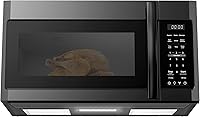
The GE model here shows the typical layout. It's a 1.6 cu ft oven with 1000 watts of cooking power and 10 power levels, mounted 30 inches wide above the stove.
A removable 12.8-inch glass turntable turns the dish so the waves reach it evenly. Turntable off is handy for large or oddly shaped pans that would catch on the sides.
Controls sit on a keypad with one-touch express settings, so you don't dial in time and power for every snack. A child lock keeps curious hands out.
What does the vent hood part actually do?
The hood part pulls air up from the cooktop, passes it through a filter and pushes it away. When you fry bacon or boil pasta, the fan captures the smoke and steam before it drifts across the kitchen.
The fan sits at the top of the unit, above the oven cavity. Air enters through grilles under the microwave and behind it, so a big part of the job is done before odors ever reach your ceiling.
That is why an over-the-range microwave works as both an appliance and a hood. If you're still sorting out the name, our explainer on what does over the range microwave mean breaks down the term and its parts.
Buyers often picture a full-size range hood. A built-in microwave vent is smaller, and its reach depends on the fan strength and how the air leaves the house.
Recirculating vs ducted: how does the air leave the kitchen?
Recirculating units clean the air and blow it back into the room. Ducted units send it outside through a wall or roof vent.
Most over-the-range microwaves can do either, depending on how yours is set up.
In a recirculating kitchen, the air passes through a charcoal filter that traps fumes and odors before the fan returns it. That's why filter changes matter so much in apartments and condos without an outside duct.
In a ducted setup, the air leaves the house and the charcoal filter plays a smaller role. A damper or vent door at the end of the duct keeps outside air from coming back in.
The GE here ships with a replaceable charcoal filter for the recirculating setup, and it can be converted to outside venting when a duct is already in place.
How does the exhaust fan move smoke and odors?
The fan is rated in CFM, or cubic feet per minute, which is how much air it moves in that time. The GE delivers 300 CFM through a 2-speed fan, enough for everyday frying, steaming and boiling.
Higher CFM means more air moved, which helps with heavy cooking. A bigger fan also runs louder, so many units offer a low speed for light jobs and a high speed for searing.
Two speeds are the common setup on this type of microwave. You pick low for a simmering pot and high when the pan starts to smoke.
The fan runs on its own, too. You can flip it on while the microwave is off to clear the stove area, which is useful when you're cooking on the burners only.
What do the filters do, and how often do you change them?
There are usually two filters: a grease filter you wash and a charcoal filter you replace. The grease filter catches the fat that floats up from the stove; the charcoal filter handles smells.
The grease filter is often a mesh panel at the bottom of the microwave. You can pull it out and wash it by hand or in a dishwasher, depending on the model.
The charcoal filter is the one that ages out. In a recirculating kitchen it does the odor work, and a tired filter lets cooking smells linger.
A 3-pack of WB06X10807 charcoal filters covers about 3 changes. FIMXSD says to swap the filter every 3–6 months to keep the air fresh, which is a good rhythm for anyone who cooks most days.
The filter sits on top of the grille behind the vent, so you lift it out and drop the new one in without tools. For the full replacement routine, see our guide on replacing over the range microwave filters.
How does the microwave stay safe and easy to clean?
Several features keep an over-the-range microwave usable in a busy kitchen. The child lock stops accidental starts, which helps in shared or family homes.
The turntable on/off setting helps with big dishes. You turn it off when a casserole dish would bump the walls, and leave it on for normal plates.
The stainless steel cavity and removable glass tray wipe clean fairly easily. Splatters on the inner ceiling come off with a warm, damp cloth after the unit cools.
A digital display and electronic keypad give you precise time and power, so you can set 30 seconds or 5 minutes without guessing. The one-touch settings cover the most common jobs.
Where does the microwave sit, and why does the size matter?
An over-the-range microwave mounts above the stove, usually under a cabinet, at roughly 30 inches wide. The GE measures 29.87 in wide, 16.12 in high and 15.56 in deep, the common size for a standard cabinet gap.
Depth matters because the unit hangs over the cooktop. A very deep microwave can crowd the back burners or block the view of the stove.
Width matters because it has to fit the cabinet opening. That's why our side-by-side on over the range vs countertop microwave is worth a read before you commit to one or the other.
If your kitchen already has a 36-inch cabinet gap rather than a 30-inch one, a trim kit fills the leftover space.
What does a trim kit do in an over-the-range setup?
A trim kit closes the side gaps between a 30-inch microwave and a wider cabinet opening. It makes the install look built-in rather than floating.
The Universal kit is a 2-piece side filler set for 30-inch models in a 36-inch opening. It's compatible with part number 8171339 and suits Whirlpool, GE and Maytag models.
The panels are stainless steel with a titanium-plated brushed finish, and the mounting screws are included. Pre-drilled holes mean a standard screwdriver handles the job.
Remember it's side panels only, not a full 4-sided frame. If your gap runs across the top or bottom too, this kit won't cover those edges.
Which one works for your kitchen?
If you want one appliance to cook and vent, an over-the-range microwave does both, and the GE 1.6 cu ft model covers the everyday needs: 1000 watts, 10 power levels, a 300-CFM 2-speed fan and a charcoal filter for recirculating setups.
Pair it with the charcoal filters if you recirculate and cook often, and add the trim kit if your cabinet opening runs wider than 30 inches. For a darker finish to match your kitchen, browse the black over the range microwave picks, or see the over the range microwave ovens white options for a light cabinet run.
The decision rule is simple. Choose recirculating when there's no duct and odor control is the main goal; choose ducted when a vent already exists and you want smoke and steam out of the house.
Frequently asked questions
Why does my over-the-range microwave need a charcoal filter?
A charcoal filter traps odors and fumes from the air the fan pushes back into the kitchen. Recirculating setups rely on it.
In a ducted setup the air leaves through the wall or roof, so the filter matters less.
Can an over-the-range microwave run without being vented outside?
Yes. Most models ship set up to recirculate, pulling air through a filter and blowing it back into the room.
You can switch one to outside venting if a duct is already in place above the cabinet.
Does the hood fan run at the same time as the microwave?
They work independently. You can run the fan while the microwave is off to clear smoke from the stove, and you can cook in the microwave with the fan on or off.
The fan usually has 2 speeds, sometimes more.
Does an over-the-range microwave save counter space?
Yes, and that is the main reason people choose one. It mounts above the stove, so the counter below it stays clear.
The trade-off is that it also limits the headroom over the burners.